

Author: Newsroom
Los Angeles, CA (January 22, 2026) — The Natural History Museums of Los Angeles County (NHM) today announces the creation of the Samuel Oschin Global Center for Ice Age Research at La Brea Tar Pits, marking a major step in the multi-year transformation of the world-famous site. Made possible by a major leading philanthropic gift from the Mr. and Mrs. Samuel Oschin Family Foundation – the largest in the history of NHM – this new world-class research center advances a comprehensive reimagining of the Tar Pits’ campus that will further cement it as a global destination for scientific research, education, and public engagement.
With the extraordinary generosity of the Mr. and Mrs. Samuel Oschin Family Foundation, NHM has now raised $131 million in pledges toward the $240 million goal of the Reimagining La Brea Tar Pits Campaign.
More than a building, the Samuel Oschin Global Center for Ice Age Research will be a research-and program-driven entity woven throughout the Tar Pits campus and scientific work. Through international research partnerships, educational initiatives, and digital platforms, the Samuel Oschin Global Center for Ice Age Research will enable La Brea Tar Pits to better share discoveries, support collaboration, and position Los Angeles as a global hub for scientific discovery that is relevant to how we live both today and in the future.
“There is no place on Earth like La Brea Tar Pits. It is fitting to honor my husband Samuel Oschin’s legacy by supporting science and research in the heart of Los Angeles, a city he helped to develop and shape,” said Lynda Oschin, Chairman of the Board and Secretary of the Mr. and Mrs. Samuel Oschin Family Foundation. “Sam and I started the foundation in order to inspire future generations by supporting organizations that deepen our understanding of the world around us. Through this work, I know the lessons of Ice Age Los Angeles will inspire countless scientists and young students here and globally.”
The Samuel Oschin Global Center for Ice Age Research will support NHM’s broader goals for the complete transformation of the Tar Pits’ 13-acre site, which has not been renovated or considered comprehensively in the half-century since the museum opened in 1977. Led by architecture firm WEISS/MANFREDI, the capital project will create a more integrated experience of both the museum and the landscape in Hancock Park.
Today, NHM is also unveiling new renderings of the transformation. The design’s new, 1-kilometer triple pedestrian loop connects active excavation sites, research and exhibition spaces, and central green into a single, continuous experience. Iconic features such as the museum’s historic frieze and beloved grass slopes are preserved and expanded while improving research and exhibition spaces, increasing community access, and creating a newly sustainable infrastructure.
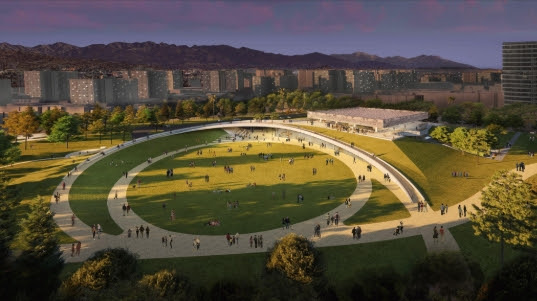
The new museum entrance and tapered gallery window frame views into the museum from the central green, while the renovated research labs, education spaces, and exhibition galleries bring close connections between science and discovery. The ascending crescent of sloped walkways introduces accessible routes to the park’s beloved grass slopes, providing universal access to a roof terrace with views of the museum’s historic frieze and the Tar Pits Campus. New Pleistocene gardens at the Wilshire Boulevard entry and within the museum courtyard connect the landscape and ecology to the Ice Age history of the site.
“The Samuel Oschin Global Center for Ice Age Research marks a critical milestone for the future of La Brea Tar Pits,” said Dr. Lori Bettison-Varga, President and Director of the Natural History Museums of Los Angeles County. “The Mr. and Mrs. Samuel Oschin Family Foundation’s transformational gift allows us to amplify the research that has always been at the heart of the Tar Pits, and to more fully integrate it into a revitalized and modernized campus that connects science, landscape, education, and community in powerful new ways. With cutting-edge research as its core mission, the reimagined Tar Pits will be one of the most consequential scientific and cultural sites in the world.”
The La Brea Tar Pits project will tell the story of Los Angeles’ Ice Age past, when mammoths and dire wolves roamed the landscape, connecting the research and science that takes place at the site with the visitor experience. Amsterdam-based design studio Kossmanndejong (KDJ) is leading the design of the exhibition spaces and outdoor experiences to create a narrative journey that activates the Ice Age collections with immersive installations and interactive experiences.
“As we all endure the effects of a changing planet, there has seldom been a more important time to expand opportunities to discover our natural world. This generous support helps make that possible for countless Los Angeles County residents through the transformation of the La Brea Tar Pits—one of the world’s most important geologic sites,” said Los Angeles County Supervisor Holly J. Mitchell. “This project prioritizes the creation of accessible educational facilities, providing world-class learning opportunities for our communities and future scientists and civic leaders.”