Press release from Natural History Museum of Los Angeles County
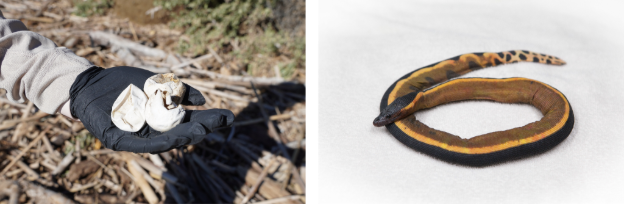
Olive ridley sea turtle eggs found in Santa Barbara County by United States Fish and Wildlife Service; Courtesy of USFWS (Left). A yellow-bellied sea snake recovered during a previous El Niño; photo by Edgar Chamorro Gonzalez, Courtesy of NHMLAC (Right).
WHAT:
This winter, El Niño has brought strangers to SoCal’s shores, washing up yellow-bellied sea snakes and the first recorded nests of olive ridley sea turtles. The super-heated ocean waters from the El Niño phenomenon alter the normal patterns of these reptiles, luring the sea snakes into currents that become too cold for them during the winter. Experts think the sea turtles are also following the warmer waters, which are especially enticing as some of their more tropical nesting beaches become too warm.
The eighth yellow-bellied sea snake ever recorded in Southern California washed up this past weekend, and Natural History Museum of Los Angeles (NHM) Curator of Herpetology Dr. Greg Pauly, along with colleagues from the United States Fish and Wildlife Service, identified the northernmost and earliest sea turtle nesting site yet. This nest was found at a Santa Barbara County beach and was likely laid even before the mid-September nesting events in Orange County. Examination of the salvaged eggs and embryos revealed that some were likely within days of hatching. The discovery of this nest suggests that olive ridley sea turtle eggs could successfully incubate in California within certain environmental conditions. Dr. Pauly is almost certain that more turtle nests and sea snakes are to be found on our coasts this winter.
“The best time to look for any of this stuff is at least an hour and a half after the high tide,” says Dr. Pauly, who’s happy to discuss the importance of finding these specimens and what their changing behavior means in the face of our warming planet, such as:
• Myth-busting common fears about venomous yellow-bellied sea snakes
• How to identify sea snakes, sea turtles, and sea turtle eggs
• What might be happening to sea turtles showing up in Southern California for the first time
• What this all means for marine reptile conservation and the animals’ future survival
• What you should do if you find one of these reptiles
Fangsgiving and Hissmass Sea Snake and Sea Turtle Search
The Museum is encouraging families to stroll beaches from San Diego to Santa Barbara Counties and look for rare reptiles over the Thanksgiving and Christmas breaks with the launch of the Fangsgiving and Hissmas Sea Snake and Sea Turtle Search.
This winter community science program hopes Southern Californians can help us study these SoCal newcomers by keeping an eye out while walking the beach after the high tide has receded. The high tide line is the most likely place to find sea turtle eggshell fragments, exposed sea turtle eggs, or stranded yellow-bellied sea snakes.
Report any nesting sea turtles or possible sea turtle eggs uncovered through beach erosion to local lifeguards. If a lifeguard is unavailable, please report the incident by contacting the NOAA California Sea Turtle Stranding Line at (562) 506-4315 and/or by submitting a report to the West Coast Sea Turtle Sightings Submission Form.
WHO:
Dr. Greg Pauly, Herpetology Curator at the Natural History Museum
WHEN:
The best time to discover these rare creatures is now through February. The high tides between now and Sunday, Nov. 29 have a higher likelihood of bringing a sea snake to shore as well as uncovering previously unknown sea turtle nests. The next windows for sea snake activity will be December 4–11 and 20–27, although onshore wind events and storm surges can also bring them ashore outside of the lunar tides.
WHERE:
Dr. Pauly is available for in-person or remote interviews. Based at the Natural History Museum of Los Angeles County at 900 Exposition Blvd, Los Angeles, CA 90007.
SAFETY FIRST:
WARNING: People should avoid high tides, be observant of waves, including possible sneaker waves, and follow local closures due to coastal flooding. The sea snakes are venomous and should not be handled. They can be photographed from a distance, and then lifeguards should be informed.